Part one: Project 2: Open-space construction

Project 2: Open-space construction

‘Aqua’ (2019) Stevens.D. Metal, plastic, glass and concrete.  60 x 150 cm

I chose the translucent red tube because it represented a conduit for water. Water was my subject of interest. I set about sourcing any discarded items that I could use to construct a sculpture that might portray my subject. I found a plastic watering can. I decided that this might be useful as the main focus. I drilled a large hole at the base of the can. The hole was big enough to fit snugly around the red tube. For rigidity, I hot glued them together. I considered the stance, poise and weight when deciding on the base. I needed something of considerable weight but not too showy. I found a small concrete block with a hole. This was perfect. The diameter of the hole was a little too large so I had to think about how I could secure the tube to the block. I placed the tube in the hole and poured Crystacal plaster into the cavity. The weight of the block allowed me the freedom of adding weighty objects whilst maintaining stability.

The beginnings
Building an idea
A plinth?


I now had the bones of the subject but I had to think about where this idea was going to lead me. How could I expand beyond this basic shape? Of course, there is so much to say about water, vital in sustaining all known forms of life on earth. I thought I might choose mundane but contrasting objects. This approach had all the possibilities of translating into the different ways in which water is regarded in both developed and developing countries. I thought about so many issues surrounding water. The Water Aid project calculates that 844 million people don’t have nearby access to clean water. Well over two billion do not have a toilet. Here in the UK, many are disgruntled at any suggestion of a hosepipe ban. I found an old car wing mirror and glued it to the filling hole of the watering can. Can I just look at myself for a moment? Can I feel easy about watering the petunias in the garden when confronted with these uncomfortable truths? The watering can is ‘holding a mirror up to society’.

Holding the mirror up to …
Tap and hose added


Each particular element in combination with the subject could have multiple connotations. There are current concerns about plastics contaminating the world’s oceans. Should the water ‘industry’ be in the hands of private companies? Why are golf clubs exempt from hosepipe bans? Industrial and agricultural expansion is contributing to drought conditions across the world. What is being done to tackle these problems? The sculpture needed more aquatic touches. I resolved to throw the kitchen sink at the structure. I found an old shower hose and a brass tap. I fixed the hose to the side of the watering can. I had to glue a threaded fitting in place to accommodate the hose. The hose was a bit flimsy. In order to give it some shape, I placed stiff but malleable wire inside the hose. This allowed for some creative coiling. I glued the brass tap into the spout and attached the other end of the hose. The diagonal lines of the watering vessel express a feeling of movement. Its position suggests instability whereas the vertical lines of the Perspex tube convey a sense of height and importance.

I bolted a rather uninteresting piece of wood on to the tube in a horizontal position. Could this be made to subliminally symbolise the death of marine life? I found some 3 mm wire and some plastic mesh. Already, I’m thinking about a shrimp net. This could lend itself to the theme. I fashioned and cut the wire into a semi-circular shape. I drilled a 4 mm hole at each end of the wood and fed the wire through. I glued each end into place. I then placed and glued the mesh over the wire and trimmed the excess with scissors. These additions seemed to add greater stability. At this stage, each part is relating one to another. I have an overwhelming urge to spray paint the entire composition. I want everything to appear uniformly neat and clean. Could a neutral shade better expose sharp lines? The existing cacophony might strike a discordant note and perhaps that is what I’m subconsciously trying to achieve. Am I aiming for harmony or conflict?

Four millimetre hole
Feeding the wire


Sketch in pencil and charcoal
Adding and trimming the mesh
Enmeshed

I left my sculpture for a few days and concentrated on my research. Upon returning with fresh eyes, I felt I needed to add one or two items. Of course one has to draw the line somewhere. I decided to add a sink waste trap and a water symbol made up from wire strapping, wire and two circular cuts from a drainpipe. Any more than this and the project would present as too busy in my opinion. I glued the trap on to the can using my hot glue gun. Again, using the gun, I fashioned and affixed my symbol to the highest point. This whole process has ignited the critic within me. If I’m honest, aesthetically speaking, I don’t like my creation. This could have gone better but I can take comfort in the knowledge that my endeavours will improve with practise.

Symbol assembly
Cutting the circles for the symbol
Affixing the trap
Affixing the symbol
Aqua: Pencil and watercolour
End game 1
Aqua: Pencil and water colour
End game 2
Aqua: Pencil
End game 3


Part one: Project 1: Shallow relief sculpture

Shallow relief sculpture

So, straight in at the deep end. This was my first attempt at constructing a shallow relief sculpture. Choosing a subject seemed like a simple suggestion but had me flitting from one idea to another. I finally settled on a marine theme. I could find plenty of useful objects along the coastline. I resolved to find a mix of organic and man-made items. I wanted to create something erratic and unsettling. I must live near one of the cleanest beaches in the UK. My search was not only hampered by gale force winds but there seemed to be a lack of material. Following a long trudge across the pebbles, I managed to collect enough ‘found objects’ for my project. Pett Level finally relinquished its treasures. My hoard consisted of random, smooth pebbles, many shells, driftwood, plastic odds and ends, a fishing net and a child’s beach shoe.

Observational A3 drawings of my collection of objects.


Tonal drawings on A3.


Trying out different arrangements.


I cut a square from plywood board. Measurements 60 x 60 x 1.8 cm. I smoothed the edges with sandpaper and gave it a coat of oil-based undercoat followed by a coat of white acrylic paint. I scattered all of my found objects onto the dry board. At this stage, I started to let my mind wander. What was it that I wanted to achieve? I wanted to be radical and create something that would convey a message. The beach and my collection got me thinking about asylum seekers. The treacherous journeys that some undertake. The child’s shoe amidst a pile of shells re-enforced this idea of highlighting the plight of people fleeing persecution. I had difficulty determining what was meant by subject. Was ‘subject’ the beach, the collection of items, the asylum seeker idea or the concept of the proposed sculpture? I needed to know exactly what I was supposed to sketch. I eventually settled on different formations placed around the board.


Each arrangement had its merits but all had an uneasy look. Initially, I think I tried too hard to achieve something pretty or easy on the eye. I finally decided on a mix of twee and random that would reflect my thoughts. I placed the shells along the four edges of the board, alternating the position of each one as I went along. This created a twee framing for the shambolic confusion that lay within. The juxtaposition of the natural elements and the child’s shoe seemed to accentuate the idea of treacherous sea journey’s made by refugees. Those that survive and reach dry land, encounter yet another hostile environment. They are often met with indifference and resentment from their new host country.


I glued each piece to the board with a hot glue gun. I affixed two mirror brackets and hung the piece on a white wall. It wasn’t long before a couple of large pebbles fell to the floor. The porous nature of the pebbles proved to be incompatible with the glue. I decided to coat the underside of the pebbles with a sealant and this resolved the problem. The work was crying out for something more profound. I remembered I had a pile of small human skulls in my studio. These were produced from a small silicone mould and had accumulated over many years. They were testers for different materials. I placed four of these skulls within the frame. The skulls would represent the one in eighteen refugee lives lost at sea between January and July 2018 (UNHCR figures). My composition had now taken on an uncomfortable look. I took things a stage further by adding red paint. I was reticent to start. Was I going too far? maybe. It was an uncomfortable truth so no point in holding back. I can now stand back and appreciate the boldness of the work.


The red coating lends a stark uniformity to an otherwise blunt, bland formation. I lost the contrasting colours of each item but gained greater depth. Red is an emotionally intense colour synonymous with strength, passion, war, power and blood. I did encounter an unexpected problem when photographing the finished work. I discovered how reflective the colour can be. The use of a gloss finish seemed to exacerbate this. The photographic imagery loses something. It seems flat and out of focus. The photos still capture the elements but not to the desired degree. It certainly looks better in the flesh. I did leave the work hidden for some days. On my return, it still resonated with me. It’s still unbending and uncomfortable to view.


Part one: Construction and drawing:

Research point

Arkhitektons: Kazimir Malevich

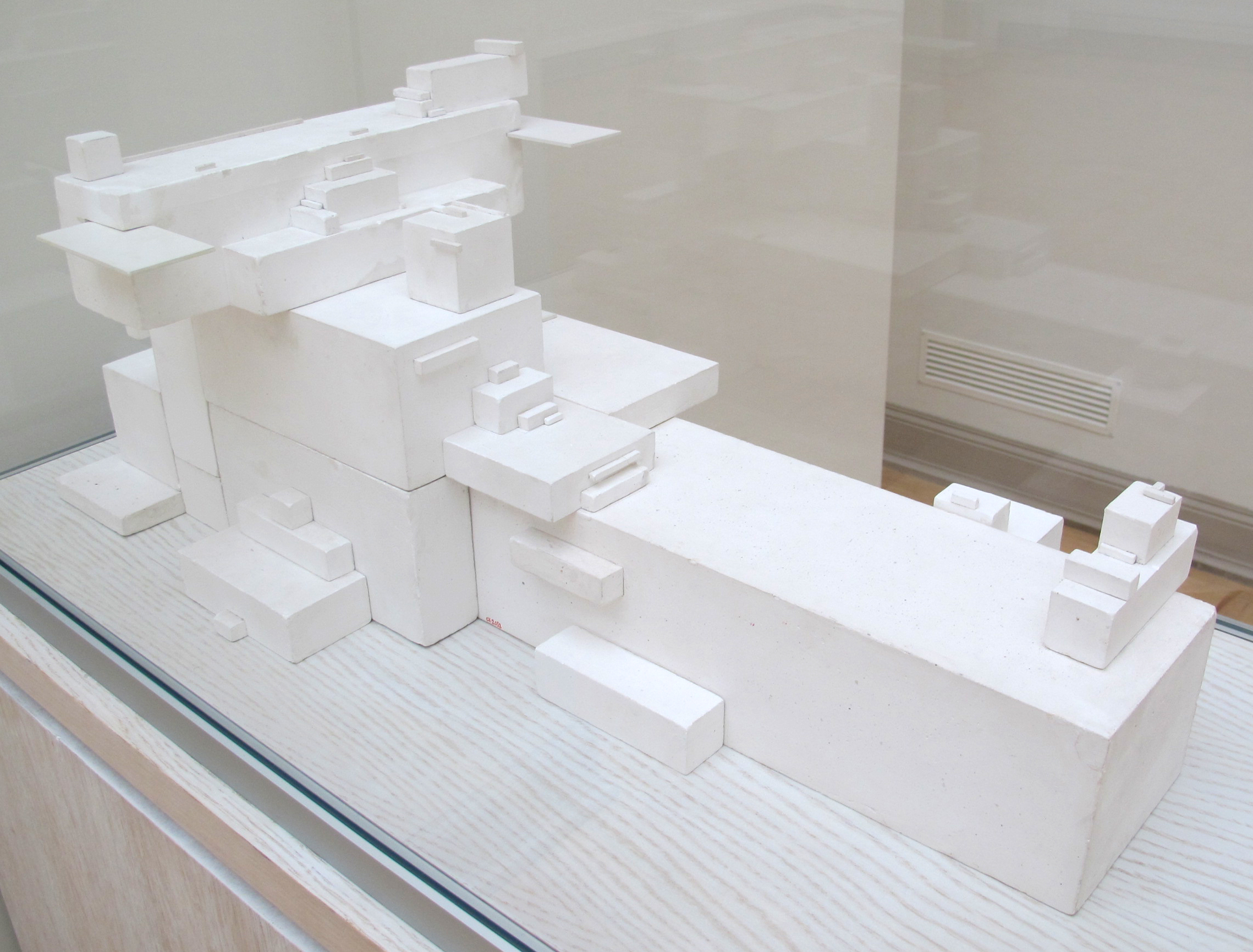
Malevich began the Suprematism art movement in 1913. It concentrated on basic geometric forms like cubes, lines, rectangles and squares. It’s interesting to note the similarities between Ben Nicholson’s c.1936 (Sculpture) and that of Malevich’s Arkhitektons. Malevich’s three-dimensional models bear a resemblance to skyscrapers. His accompanying drawings are called ‘planits’. The models are mostly made from plaster rectangles added together. They usually consist of a large central block as the main element with additional, smaller parallelepipeds. No function is demonstrated or interpreted by form. The end results are pure assembly of abstract vertical and horizontal masses. According to Fabrizi (2015), they embody formal non-objectivity and spatialization. These Arkhitektons demonstrate Malevich’s attempt to convert his suprematist doctrine of composition to that of architecture and 3D forms.    

Kazimir Malevich: Arkhitekton Alpha (1923)
Kazimir Malevich: Arkhitekton (n/d)


Wagon II 1964: David Smith

This sculpture is one of a series of three. Consisting of forged steel, it was cast at a commercial foundry called American Forge. The extra-large fourth wheel was manufactured from five steel plates welded together. The sculpture was exposed to the elements for one season. The accumulated rust was then removed. It was finished with a coat of Masury oil. Smith quoted ‘the red of rust has a higher value for me than antiquity relationship. It is the red of the east’s mythical west. It is the blood of man, it was on culture symbol of life’ (Marcus p.158). Each of the smaller wheels weighed 275 pounds and were originally intended to carry the weight of a hundred-ton trolley car.

David Smith: Wagon 11 (1964)

Eilis O’Connell

O’Connell’s abstract sculptures are influenced by her interest in architecture, archaeology, found objects and geometry. Equally, she instinctively uses organic forms, drawing her inspiration from the body. She uses a variety of media but metal is her favoured medium. Much of her work is large scale. O’Connell shuns the use of CAD programmes, preferring to make 3D scale models of her projects. Below are three objects based on geometrical spiral forms. They were made from resin and carbon fibre.

Eilis O’Connell: Stem (2008)


Eilis O’Connell: Loop (2008)

Eilis O’Connell: Curve to point (2008)


Reference list

Fabrizi, M. (2105) Kazimir Malevich’s Arkhitektons [online] Socks. Available from: http://socks-studio.com/2015/07/15/kazimir-malevichs-arkhitektons/[Accessed 30th March 2019]

Gale March, M. Revised (2001) David Smith: Wagon 11 (1964) [online] Tate. Available from: https://www.tate.org.uk/art/artworks/smith-wagon-ii-t07516  [Accessed 30th March 2019]

Bibliography

Marcus, E. (1983) David Smith: The Sculptor and His Work, Cornell University Press, London.

Images

Unknown (n/d) Wagon 11 [online image]. Art Fund. Available from: https://www.artfund.org/supporting-museums/art-weve-helped-buy/artwork/7180/wagon-ii  [Accessed 30th March 2019]

Unknown (n/d) Eils O’Connell [online] & [online images]. Cass Sculpture Foundation. Available at: http://www.sculpture.org.uk/artist/eilis-oconnell [Accessed 30th March 2019]

Unknown (n/d) Arkhitekton Alpha [online image]. Available at: https://upload.wikimedia.org/wikipedia/commons/b/bb/Kazimir_malevich%2C_alpha_architecton%2C_1920_01.JPG  [Accessed 30th March 2019]

Unknown (n/d) Arkhitekton [online image]. Available at: https://thecharnelhouse.org/2014/03/12/suprematism-in-architecture-kazimir-malevich-and-the-arkhitektons/#jp-carousel-18118 [Accessed 30th March 2019]