Research point: Developing construction
Jacques Schnier (1898-1988)
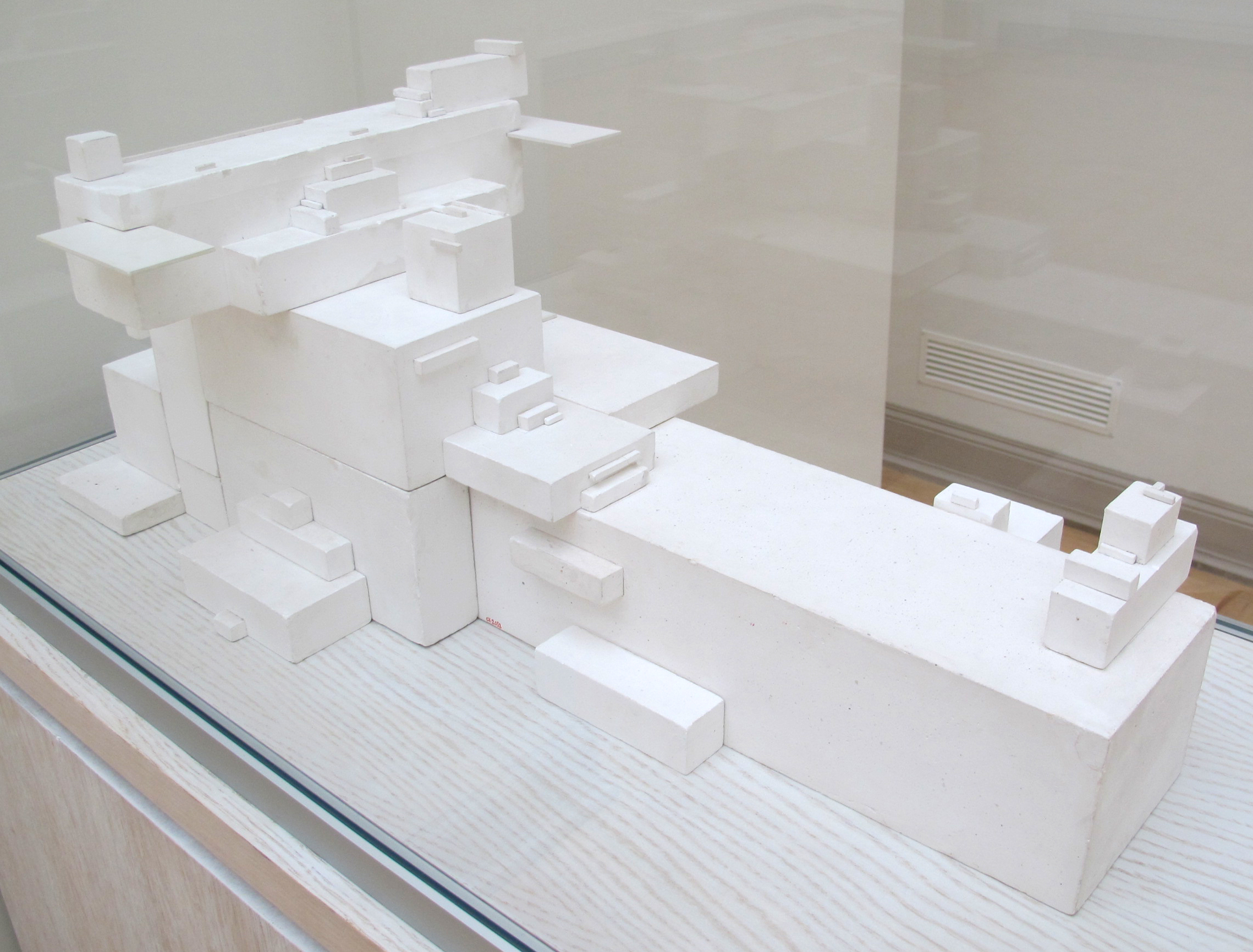
Cubical Variations Within Rectangular Column (1961)
After abandoning figures post WW11, Schnier went on to sculpt in a style related to Cubism. He explored the relationship between volume and space within geometric forms. From the late 1960’s onward, he experimented and incorporated industrial materials into his work.


Peter Startup (1921-1976)
Falling Figure (1960) Wood
Startup’s sculptures were attentively fashioned. They usually consisted of two or more forms of wood. Further unrelated materials were often inserted into the pieces. His work wavered somewhere between figuration and abstraction. Many of his sculptures are flexible. They comprise elements that can form disparate arrangements. He began using ‘found’ wood by the end of the 1950s. He developed an idiosyncratic topic featuring wood figures. These were assembled in a basic, haphazard style that defied and rejected the practice of fine joinery. Startup said of the confliction of his chosen components, ‘they are part of the discarded junk of urban life and through them, I want to find relationships which surprise and excite me and that project an image through the terms of classical sculpture- that is, in terms of space and volume’. Startup used wood as his preferred material for his assemblages. These pieces took on totemic, metamorphic forms.


William Turnbull (1922-2012)
Idol 2 (1956) Bronze
Turnbull produced five sculptures bearing the title ‘Idol’. Each piece resembles a standing female character. Idol’s 1 and 2 are overly figurative, whereas 3 and 5 are more geometric with 4 being markedly smoother. For Idol 2, Turnbull embedded corrugated cardboard within the plaster. The resulting ribbed texture defines the breasts, legs and hair. On writing about Turnbull’s 1973 Tate retrospective, Morphet (1973) noted how the sculptures resembled ‘archaic spearheads or blind sentinel’s’. He goes on to suggest that the figures flat and still features relate more to those of Egyptian and Ancient Greek origin. The title ‘Idol’ refers to contemporary ‘screen idols’ and those of pre-history. These high and low references aid our understanding of modern culture. As viewers, we are besieged by imagery past and present.


Constantin Brancusi (1856-1957) Endless Column (1937), Steel & Bronze Paint, Targu Jiu, Romania
Endless Column ( 1938) comprises fifteen hollow, giant pellet-like segments. Each piece is stacked to form the towering ninety-six-foot-high sculpture. Half sections are placed at the base and the summit. The entire piece is made from cast iron and sprayed with a metallic bronze finish. If you were to stand close by and glance up toward its ascending form, the work would appear to be a boundless litany of edges and planes. Its element of simplicity has a deceptive quality. It allows the viewers imagination to run riot with its repetition. Paradoxically, the column seems to have more edge than plane. The zig zag, razor sharp edges seem to cut into the sky in two parts whilst seemingly binding it back together. Its weird how this column counters the laws of one-point perspective. According to George (2014), one might expect to see the sections decrease in size as the column soars but they remain the same when viewed in the flesh. A fine example of the gap between perception and what is actually visible.

Brancusi’s figurative works such as Adam and Eve 1921, may well have been inspired by African sculpture. These sculptures show a clear relationship to the ‘primitivism’ inspirations he’d experienced early on in his career. Paul Gaugin’s use of direct carving to re-create the organic nature of indigenous, Tahitian carvings appear to have influenced Brancusi’s work. It is easy to see how some scholars argue that Brancusi’s work might also have been inspired by the Romanian folk carvings from the country of his origin. Brancusi’s work encompasses architecture, furniture and sculpture, whilst evoking spiritual reflection.


Julio Gonzales
Julio Gonzales’s creative period occupied a relatively short space of time. War and poverty was manifest in his work. He associated with the local traditional crafts of Barcelona. This was to influence his take on form and his preferred medium, He’d attained a high level of welding skills during the first world war. Those skills would allow him to express paradoxical, broad-ranging concepts. His sculptures encompass a variety of abstract forms attributed to surrealism, constructivism and cubism. He collaborated with Picasso and is renowned as the ‘father of iron sculpture’. Gonzales chose iron as his medium in protest of its use for munitions and the mechanisation of society.
Gonzales drew inspiration from Picasso’s approach toward communication between painting and sculpture. This led Gonzales to interpret forms in space within his own output. He appreciated space as a new medium with which to construct and shape his art. He would go on to formulate his ‘drawings in space’. This method utilised the surface and lines in the sculpting materials. He produced open constructions using space to represent the human body or female figure. Gonzales used drawings as a means to test out new ideas when the availability of materials was limited. The drawings emphasise the effect of shadow and light on the architecture of spatial form. The influence of 16th-century artist, Luca Cambiasso can be seen in Gonzales’s work, often depicting human figures in cube form. Gonzales influenced the works of David Smith and Anthony Caro.
During my research I found the following contemporary sculptors working in a vertical way.
Jose Davila (1974)
Davila is a Mexican sculptor. He employs a variation of replication procedures that deconstruct the relationship between content and form. His education as an architect and self taught historian is evidenced in his body of work. This work queries the boundaries of contributory values over the adoption of familiar elements in the creation of objects, sculptures and installations. His work relates to Arte Povera and Minimalism. His interest lies within the occupation and use of space. The image below is part of an installation titled ‘Not all those who wander are lost’. It was presented at the Royal Botanical Gardens in Madrid. The installation hints at the history of sculptural language that takes in the different functions of columns. From construction support and decoration, through to totems used for religious and spiritual purposes. His work pays homage to Mexican architect Luis Barragan and sculptor Donald Judd. Using building material and found objects, he merges industrial with organic. Classical and Minimalist aspects are brought to the fore.


Giorgio Andreolla Calo (1979)
His work centres around large site specific installations. His spatial works alter both landscapes and remnants of buildings. They generate a connection between the symbolic aspects of water, fire and light. Calo prefers to work in wood, bronze and clay. Much of his work appears totemic with overtones of deterioration. Untitled (2015) appears to make reference to the work of surrealist sculptor Giacometti. Calo’s mix of mysterious imagery represents a resurrection of totems that give a sense of primative humanity. Calo explains; “I am more interested in the paradox of adopting a system so old that it stems from the origins of figurative art to create a contemporary vision of the present, and to do it in a place given over to the art of our times”.

Tony Cragg (1949)
British sculptor Sir Tony Cragg places no limits on the materials he uses for his creations. His works appears to blur the lines between natural and man-made landscapes. He interprets sculpture as an examination of how matter and its varied forms alter our concepts and the sentiments they evoke. Cragg explores the link between why we look as we do and why we are the way we are. Point of view (2004), takes on totemic qualities, however, the impression of permanence becomes subverted with the creative way in which he utilises polished steel. The work resembles an aquatic Archimedes screw that reflects the fleeting, delicate nature of water.

Peter Bradley Cohen (1960)
Much Bradley Cohen’s works are vertical in style. The former advertising agent took up art full time three years ago. He works with metal and found objects. His sculptures portray improbable physics. Much of his works appear to be heavily influenced by Caro. He analyses the balance and tension betwixt organic fluidity and geometric rigidity, weight and illusion of weightlessness. His work seeks to instil in the viewer, the idea that they have stumbled upon something random. His interests in cultural and spiritual objects influence the totemic style of his work.

Evy Jokhova (1984)
Jokhova experienced a multicultural upbringing exposing her to varying political and social structures. Her background influences her practice and research. She is a multidisciplinary artist that engages with relationships and discourse between architecture, sociology, art and ideology. In a recent project, Cairns; Totems, Jokhova explores the link between the developmental significance of religious objects, assemblages for shrines and crusades in modern culture. She analyses their materiality, imitation, physicality, creativity and balance. Cairns is a tribute to the human act of stacking stones. This practice is represented in mythology, spirituality and politics. Jokhova’s work emulates the totemic nature of cairns. She uses modern materials in place of real stone.

15 3/4 x 15 3/4 x 51 1/8 in
Reference list:
Artprice.com (n/d) Biography of Jacques Schnier (1898-1988) [online] Artprice.com. Available from: http://biography of Jacques SCHNIER (1898-1988) [Accessed 18th April 2019]
George, H. (2014) The elements of sculpture. London. Phaidon Press limited.
North House Gallery (n/d) Peter Startup (1921-1976) 30 Years of Sculpture [online] North House Gallery. Available from: http://www.northhousegallery.co.uk/art-exhibition/artist/peter-startup-19211976/30-years-of-sculpture/ [Accessed 18th April 2019]
Spector, N. (2019) Constantin Brancusi, Adam and Eve 1921 [online] [Wood] Collection Online. Guggenheim. Available from: https://www.guggenheim.org/artwork/663 [Accessed 20th April 2019]
Tate (n/d) William Turnbull, Idol 2, 1956 [online] Tate. Available from: https://www.tate.org.uk/art/artworks/turnbull-idol-2-t05801 [Accessed 18th April 2019]
Images:
Archiveofaffinities (2012) Jacques Schnier, Cubical Variations Within Rectangular Column, 1961 [online image] Eyeball Mansion. Available from: http://eyeballmansion.com/post/25511965770/archiveofaffinities-jacques-schnier-cubical [Accessed 19th April 2019]
Dalf (2006) Constantin Brancusi, Endless Column 1938 [online image] [Bronze] Creative Commons. Available from: https://de.wikipedia.org/wiki/Datei:Romania_20060512_-_Tirgu_Jiu_-_Coloana_fara_sfarsit.jpg [Accessed 20th April 2019]
Poussin Gallery (n/d) Peter Startup, Falling figure/ Shuttered figure 1960, [online image] [Wood] Poussin Gallery. Available from: https://www.poussin-gallery.com/site.php?artist=11&group=archive [Accessed 18th April 2019]
Unknown (2019) Constantin Brancusi, Adam and Eve 1921 [online image] [Wood] Collection Online. Guggenheim. Available from: https://www.guggenheim.org/artwork/663 [Accessed 20th April 2019]
Unknown (2018) The Szekely wood [online image] [Wood] Cristuru Secuiese, Culture and Tradition. Available from: http://www.enterrural.com/szekely-wood-carving/ [Accessed 21st April 2019]
William Turnbull (n/d) William Turnbull, Idol 2, 1956 [online image] [Bronze] William Turnbull. Available from: http://williamturnbullart.com/index.php/the-art/sculpture/idol-2/1946-1962 [Accessed 18th April 2019]


 BA Hons Creative Arts: Starting out in 3D: Sculpture 1